
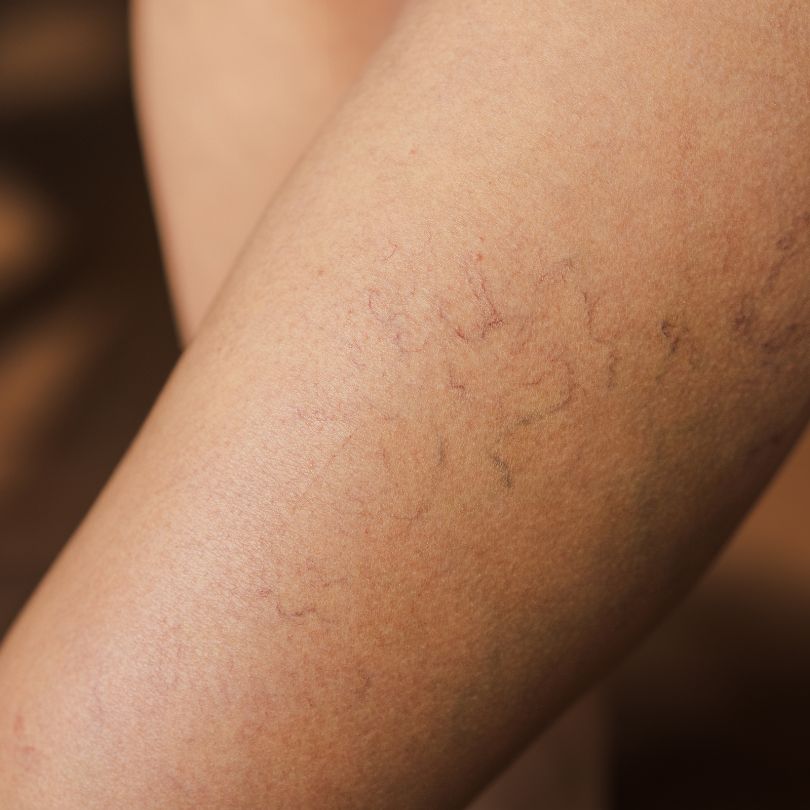
Laser treatment for spider veins is a modern, minimally invasive method for removing small, superficial veins (spider veins), which usually occur on the legs. Here is an overview of the most important information:
What are spider veins?
- Small, dilated superficial blood vessels (capillaries) directly under the skin.
- Usually reddish or bluish in color, net-like or fan-shaped.
- Common on the legs, especially thighs or calves.
- Often a cosmetic problem, rarely medically necessary.
How does laser treatment work?
- The laser produces a focused beam of light that is directed specifically at the affected vessels.
- The light energy is absorbed by the hemoglobin in the blood → heat is generated → vessel walls are destroyed (coagulated).
- The body then naturally breaks down the dead vessel.
Advantages of laser treatment
- Non-invasive (no needles, no incisions)
- Outpatient treatment possible
- Short treatment time (10–30 minutes)
- Little downtime
- Good for fine, superficial spider veins

Disadvantages and risks
- Multiple sessions often necessary (depending on severity)
- Mild pain or burning during treatment possible
- Redness, swelling, pigment changes, or small crusts in the days following
- In rare cases: Scarring or hyperpigmentation
Contraindications
- Heavy tanning or tanning bed use (increases the risk of side effects)
- Беременность
- Acute skin infections
- Blood clotting disorders
Aftercare
- Avoid sun exposure for 4–6 weeks after treatment (use sunscreen)
- No hot showers, saunas, or exercise for a few days
- Compression stockings are sometimes recommended (depending on the severity) Clinic/Doctor
 Spanish
  English
  German
  French
  Arabic
  Thai
Thai  Chinese
  Russian